The Elven sky
The celestial bodies were named by Elves. The suffix -uir means “planet.”
THE SHADOW SAGA / A READER’S COMPANION
Beyond the page.
Within the world.
Walk through the histories, peoples, and traditions behind the Shadow Saga. Begin with the world as the journey opens, then choose how much of the story to reveal.
Open the chronicle ↓Return to the Shadow Saga booksI / THE CARTOGRAPHER’S TABLE
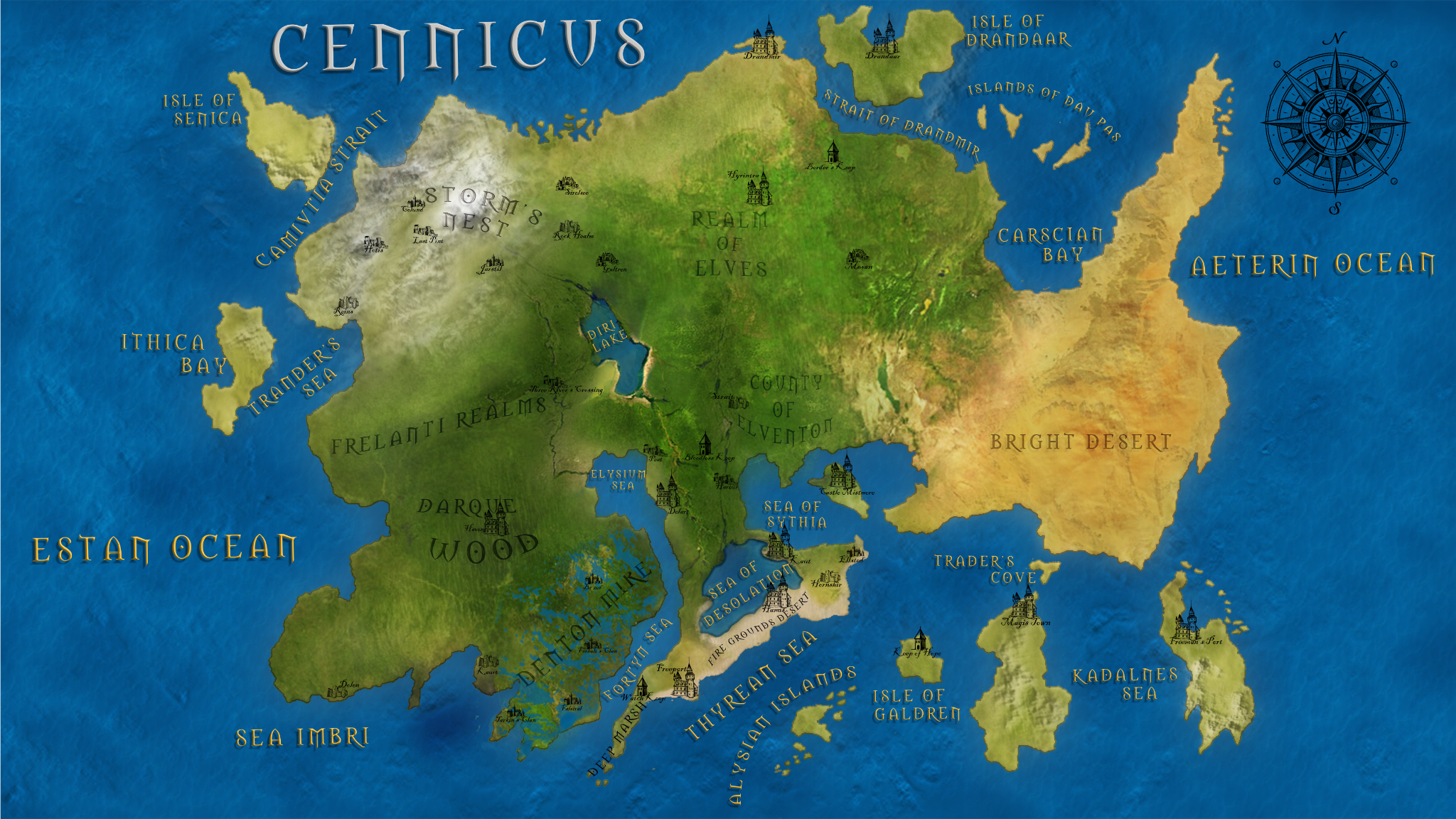
The trilogy-era atlas is being revised. The existing reference map below depicts later geography, including the Bright Desert, and is not a map of the opening trilogy’s era.
The revised atlas will preserve the continent’s shape while aligning places, borders, and terrain with the time of the novels.
Reference only—not the final trilogy-era map. The Bright Desert shown here belongs to the Second Great War.
II / BENEATH THREE MOONS
Cennicus is the known inhabited continent at the heart of the Shadow Saga. Its world, Anduir, is the third planet from Sol, a blue-white star. Three moons cross its sky: white, red, and black. In the era of the novels, the black moon is whole.
The celestial bodies were named by Elves. The suffix -uir means “planet.”
In order from Sol: Theuir, Heduir, Anduir, Veduir, Rieduir, Ioduir, Yuduir, Thoduir, Liduir, Daduir, and Keuduir.
Varethia and Thalmyr also exist. During the saga, their existence is known to Elves; other peoples do not share this knowledge unless it is revealed to them.
III / PLACES THAT HOLD A STORY
The town in which Namir’s story begins. Its inn, families, and civic council give the opening story its human scale.
The destination of Ellsted’s delegation, where a journey beyond home becomes entangled with greater dangers and responsibilities.
Also called Trogast’s Mountain. After the First Great War, the Dwarves retreat here from their separate mountain homes.
A desert created at the end of the First Great War. Its history is distinct from that of the later Bright Desert.
IV / PEOPLES & TRADITIONS
Elven history includes High, Gray, Wood, and Aquatic divisions, alongside the conflicts of Light and Darque. An early monarchy gives way to succession struggles whose consequences reach younger peoples.
Trogast is the first Dwarf. While he explores the world, the Dwarven goddess creates the others. Their clans develop distinct responsibilities in faith, craft, labor, and protection.
Drandmir and Kaufer unite during the First Great War. That alliance is not the complete unification of humanity; the kingdoms retain a longer and more complicated history.
The Calanari are the children of Tumere. Their traditions and distinctive writing carry connections to the older world.
V / THE WEIGHT OF HISTORY
Elven divisions have deepened. Dwarves inhabit separate mountains, and the human kingdoms remain distinct.
Drandmir and Kaufer form an alliance. The war draws together peoples whose loyalties and losses will shape the continent.
The Fire Grounds are created. The Dwarves retreat to Storm’s Nest. The war’s end becomes a reference point for reckoning the years that follow.
The novels begin in the aftermath of that earlier history. Old conflicts live on beneath the friendships and rivalries of a younger generation.
The black moon is destroyed in An 2768. The Bright Desert is created during the Second Great War, when Drandmir consolidates the human kingdoms. Queen Ravina rules after that later war. These are later conditions, not features to project backward onto the opening trilogy’s map.
VI / POWERS OLDER THAN KINGDOMS
The Lost Ones, the Ancients, the Elders, and the Young Ones are four distinct divine classifications. Their names are not interchangeable titles.
Relics hold the power of the Elder Gods. Their histories, bearers, and costs are revealed through the story. A power’s promise and the price of wielding it need not be the same thing.
For character-specific discoveries, choose a completed book in the character chronicle below.
VII / WORDS THAT REMEMBER
Calanari writing most closely resembles the script of the Elders. Its text runs vertically, from top to bottom. In a bound book, columns move from the spine toward the outside edge: right to left on a left-hand page, and left to right on a right-hand page.
Formal or ancient writing keeps glyphs separate; modern writing may intertwine them. Alphabetic forms, digits, and family crests belong to the system.
VIII / THE RECKONING OF DAYS
A 365-day year: eighteen months of twenty days, followed by the five-day interval Ail’faeorin. Weeks contain five days.
The five closing days are Sarné, Urenel, Itharil, Vaelorn, and Miriel.
A 365-day year with seven thirty-day months, five thirty-one-day months, and seven-day weeks.
The five thirty-first days are Goldfest, Spurfest, Jewelfest, Pitfest, and Keepfest.
A 365-day year with seven thirty-day months, five thirty-one-day months, and seven-day weeks. Feast days remain within the ordinary calendar.
Distance traditions are grouped for Elves and Dragons, Dwarves, and Humans. The recorded weight systems distinguish Dwarven and Human terms.
IX / THE CHARACTER CHRONICLE
Choose a book and meet its characters. Open a card to read the profile and study the artwork.
Story panels are hidden by default. Profiles, appearances, and Light/Dark groupings reflect the selected book and may reveal character developments.
32 cards · Shadow Dance · Story spoilers hidden